
Luteinizing Hormone Explained: What LH Really Means for Ovulation and OPKs
What Luteinizing Hormone Actually Does
Luteinizing hormone, or LH, is one of the body’s main reproductive hormones. In women, it helps trigger ovulation and supports the hormonal shifts that happen around it. In men, it even plays a role in testosterone production.
LH matters because it is part of the body’s timing system. But it is not a simple yes-or-no switch. It is one signal in a larger hormonal conversation, which is one reason LH can be easy to misunderstand. This is also why I don’t suggest using it as the only method of tracking your cycle.
Why the LH Surge Matters So Much
LH Does Not Confirm Ovulation
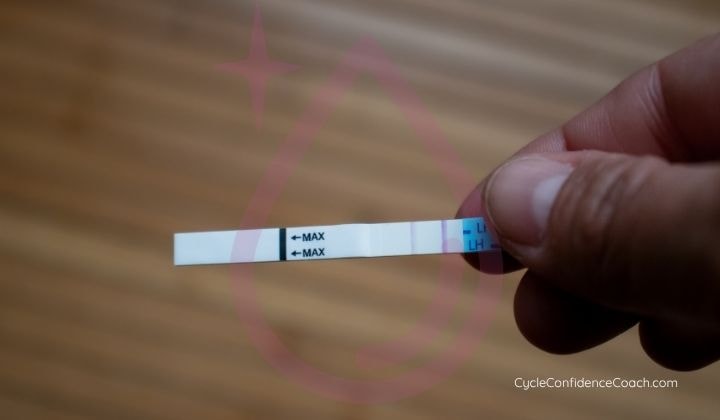
This is the biggest misconception. A positive OPK does not confirm ovulation. It only means LH has risen enough to be detected in urine.
That distinction matters. The LH surge usually comes around ovulation and the surge itself is not proof that an egg was released. So if someone sees a positive test, the right takeaway is not “I ovulate tomorrow.” The better takeaway is “ovulation is being attempted.”
Why The Timing Is Different For Everyone
People like a simple rule here, but biology does not cooperate. Some studies show ovulation may occur about 35 to 44 hours after the onset of the surge, while the LH peak itself is often closer to ovulation. With that said, other data show a wide spread in timing across cycles and individuals.
The biggest thing is that ideally we’ve been baby dancing before we see the LH surge, and then we want to keep up the fun for about 2 days past the surge ending. If we wait for the surge to start and don’t realize we ovulated really early in the process, we may entirely be missing our best fertile time!
That means the most useful way to think about LH is as a window, not a countdown. A positive OPK can be helpful, but it is not a universal clock. It is a signal that has to be read in context and best paired with other data.
Why You Might See Positives For More Than One Day
This is another area where people often jump to the wrong conclusion. Repeated positives can happen because the surge is prolonged, because baseline LH is higher than average, or because the body is behaving differently from cycle to cycle.
There can also be test-related reasons. One peer-reviewed study found that very low concentrations of hCG can trigger false-positive results in home ovulation devices. That does not mean every repeated positive is fake. It means the result needs interpretation, not panic. It’s better to use test types that allow for you to monitor trends, rather than read it as positive or negative on its own.
When To Start Testing
If someone has shorter cycles, they usually need to start earlier. If cycles are irregular, testing often needs a wider window. The goal is simple enough: do not start so late that you miss the surge altogether! For help on knowing when to start testing, I strongly recommend the Free Fertile Window Blueprint Bundle mini-course (it’s a $47 value)! It demystifies timing for your particular cycles.
How To Read OPK's More Realistically
OPKs are useful because they can help identify the fertile window. A recent peer-reviewed study found that several at-home OPKs showed high accuracy compared with blood LH surge detection, though test performance still varied somewhat by brand. Remember, they aren’t a precision method. They are a signal that your chances are hopefully closing soon if TTC.
Still, accuracy does not mean certainty about ovulation itself. OPKs do not tell you if the egg released, and they do not confirm luteal phase function. They are best used as part of a bigger picture, not as a stand-alone answer.
The Bottom Line
LH is important, but it is often oversimplified. A positive OPK is not ovulation confirmation.
The surge does not follow one exact timeline for everyone. And repeated positives do not automatically mean something is wrong.
That is why so many people get stuck in the same loop. They think they know LH, but the details that actually matter usually live in the research. That is the gap your LH & OPK Cheat Sheet fills. This simple cheat sheet smashes those misconceptions and ensures you truly know how to maximize your chances using LH each cycle. If you'd like a more detailed walk-through, the LH Surge Masterclass might be just right for you. No matter what you choose, LH is a lot of work! At least you'll know you are doing it right.

Sources
American Society for Reproductive Medicine. (2024). Similar accuracy and patient experience with different one-step ovulation predictor kits. Fertility and Sterility, 123(3), 499-505. https://pubmed.ncbi.nlm.nih.gov/39326629/
Crews, B. O., Moley, K. H., & Gronowski, A. M. (2013). False-positive results in home ovulation prediction devices due to very low concentrations of human chorionic gonadotropin. Clinical Biochemistry, 46(15), 1625. https://pubmed.ncbi.nlm.nih.gov/23899580/
Cline, D. L. (1990). Luteinizing hormone and ovulation timing. American Journal of Obstetrics and Gynecology, 162(5), 1341. https://pubmed.ncbi.nlm.nih.gov/2369467/
Koukkou, E., et al. (2022). The LH surge and ovulation re-visited: A systematic review and meta-analysis. Journal of Clinical Medicine, 11(17), 4949. https://pubmed.ncbi.nlm.nih.gov/35258085/
Leiva, R., Burhan, U., Kyrillos, E., Fehring, R., McLaren, R., Dalzell, C., & Tanguay, E. (2014). Use of ovulation predictor kits as adjuncts when using fertility awareness methods: A pilot study. Journal of the American Board of Family Medicine, 27(3), 427-429. https://pubmed.ncbi.nlm.nih.gov/24808123/
Mizrahi, S., et al. (2017). Detection of ovulation, a review of currently available methods. Contraception and Reproductive Medicine, 2, Article 11. https://pmc.ncbi.nlm.nih.gov/articles/PMC5689497/
Napal, L., et al. (2024). Current ovulation and luteal phase tracking methods and their clinical utility. Frontiers in Medicine, 11, 1-15. https://pmc.ncbi.nlm.nih.gov/articles/PMC11837971/
Physiology, Luteinizing Hormone. (2022). StatPearls. NCBI Bookshelf. https://www.ncbi.nlm.nih.gov/books/NBK539