
Can You Use Ovulation Tests as Pregnancy Tests? (The Truth about LH Tests)
Have you ever seen those posts where someone shares an ovulation test and asks, “Does this mean I’m pregnant?”
The comment section is usually split, and somehow that makes it feel even more confusing instead of clearer.
If you’ve been in spaces like r/TryingForABaby or r/FirstTimeTTC, you’ve probably seen how these conversations usually go.
They tend to sound like one of these:
"Positive ovulation in luteal phase"
"LH increasing during luteal phase"
"What's this about using OPKs as a pregnancy test"
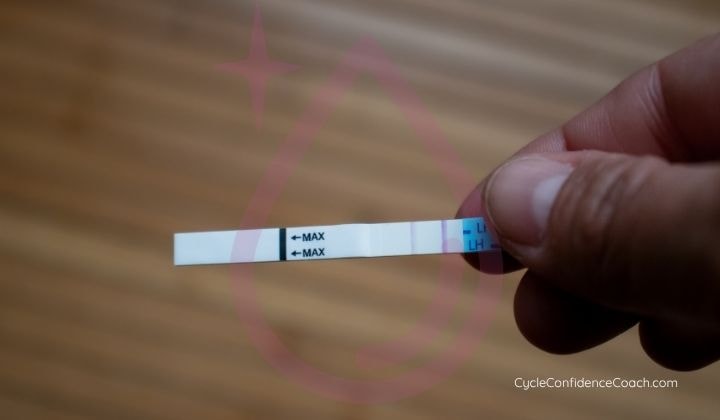
What an LH test is actually telling you
An LH test is designed to measure luteinizing hormone. That hormone rises before ovulation and helps trigger the release of an egg.
So when you’re using ovulation tests, you’re asking a timing question. Is my body trying to ovulate?
A pregnancy test is answering something completely different. It looks for hCG, which is the hormone that shows up after implantation.
Two different hormones. Two different purposes.
Why this gets confusing so easily
LH and hCG are structurally similar, which means an LH test can sometimes react to hCG. So yes, occasionally an ovulation test might look positive in early pregnancy.
But that does not make it a reliable way to detect pregnancy. It is more of a coincidence than something you can depend on.
There are also posts like this one that try to break down OPK patterns and LH behavior. It was a helpful perspective and does a nice job explaining how LH can behave across a cycle. At the same time, it's important to remember that your LH activity may have trends but they are not guaranteed to look exactly the same every cycle.
Seeing it rise again doesn't mean anything is good or bad. This is where I see so many women get pulled into a roller coaster. A darker OPK line starts to feel like a signal, like maybe this is it. Then a pregnancy test says otherwise, and the drop from that hope is hard.
Most of the time, that darker line has nothing to do with pregnancy.
Why LH can rise in the two week wait
LH does not disappear after ovulation. It stays in your system and can still fluctuate during the luteal phase.
As progesterone shifts near the end of your cycle, LH can rise a little. If you catch that at the right moment, the test line can look noticeably darker.
That is normal physiology. It is not a confirmation of pregnancy.
When a second LH rise means something else
There is one important exception to keep in mind.
If ovulation has not been clearly confirmed, a second LH rise can mean your body is gearing up to try again. This can happen more often with longer or irregular cycles.
In that case, what you are seeing is not a pregnancy signal. It is a pattern signal.
This is why one strip on one day can feel so confusing. It is only a small piece of the story.
What to use instead when the question is pregnancy

A gentle reminder for the two week wait
This is not only about getting the science right. It is also about protecting your emotional energy during a time that already asks a lot of you.
The two week wait can make every line, every symptom, every tiny shift feel meaningful. That is human.
But using LH tests as pregnancy tests often creates hope that is not grounded in what the test can actually tell you.
You deserve clearer signals.
You deserve to feel steady in how you are reading your body, even when the waiting is hard.
If you want a simple reference for reading your strips more clearly, my LH & OPK Cheat Sheet can help.
The bottom line
Use each tool for what it is meant to do.
Let LH tests help you estimate timing.
Let pregnancy tests answer the pregnancy question.
That is how you stay rooted in clarity instead of getting pulled into guesswork. The two week wait is hard enough as it is without adding more complication!

Sources
National Institute of Child Health and Human Development. (2020). Endocrinology of the menstrual cycle. In StatPearls [Book]. National Center for Biotechnology Information. https://www.ncbi.nlm.nih.gov/books/NBK279054/
Reame, N., Sauder, S. E., Kelch, R. P., & Marshall, J. C. (1984). Pulsatile gonadotropin secretion during the human menstrual cycle: Evidence for altered frequency of gonadotropin‑releasing hormone secretion. Journal of Clinical Endocrinology & Metabolism, 59(2), 328–337. https://doi.org/10.1210/jcem-59-2-328
Vivekanandan, S., & Andrew, C. E. (2002). Cross-reaction of human chorionic gonadotrophin in Immulite 2000 luteinizing hormone assay. Annals of Clinical Biochemistry, 39(3), 318–319. https://journals.sagepub.com/doi/pdf/10.1258/0004563021902053