
Chances of Getting Pregnant First Month: Real Odds + Beginner TTC Tips
So you’re peeking into the world of trying to have a baby. This is called trying to conceive (TTC). So exciting! At this point, you might also be a bit nervous. This is a big step, so that’s okay.
Maybe you just tossed your birth control. You just downloaded an app (or three). You are jumping in!
I’m so happy for you to be here and also that you found this article. You get to learn a lot of interesting information and often, the longer the journey takes the more fascinating insights you can learn about your body. Let me share some key facts first to get you started.
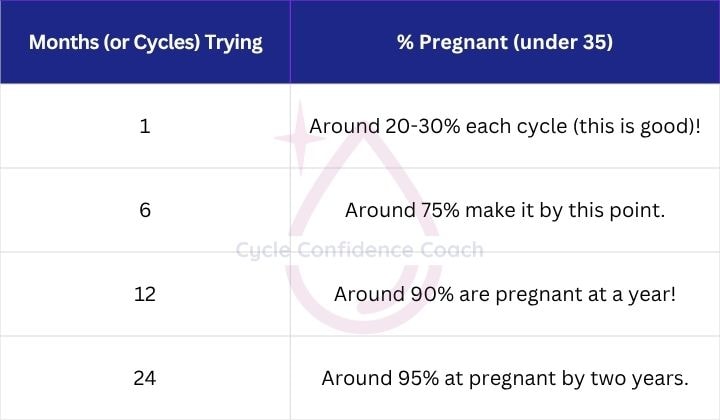
The good news: most healthy couples under 35 get pregnant in 6 to 12 months. Often, in just 2 to 4! It’s definitely not always as fast as they taught us in middle school, but this is totally normal.
Chances of Getting Pregnant
Tips for Beginners

For her (with partner help, of course):
1. Track your cycles. You can use paper or a free app. This can help you spot signs of ovulation and can cut your time trying in half!
2. Check out the free Fertile Window Blueprint Bundle mini-course. It’s your guide to where your fertile window is and when to aim for baby-making. It even covers tricky things like when cycles move around on you and birth control recovery).
3. If you are a bit swamped by lots of code words and lingo in fertility forums, you may find a TTC Lingo Decoder helpful. It’s created to decode all those acronyms and helps make a sentence a sentence again.
4. Oh, and my favorite tip of all time. Don’t do it all at once. Take just one step at a time!
If you don’t have periods and aren’t on birth control, or are on birth control and want to try for a baby see a medical professional right away. Have any known issues that could impact fertility like PCOS or past health worries (or any concerns you’d like to check on)… start the conversation with your doctor now.
Again, just one baby step at a time! You’ve got this.

Sources
American Society for Reproductive Medicine. (2021). Fertility evaluation of infertile women: A committee opinion. https://www.asrm.org/practice-guidance/practice-committee-documents/fertility-evaluation-of-infertile-women-a-committee-opinion-
Boxmeer, J. C., Steegers-Theunissen, R. P., Lindemans, J., Wildhagen, M. F., Martini, E., Steegers, D. A., & Mackenbach, J. P. (2020). Paternal folate status and sperm quality, pregnancy outcomes, and epigenetics: A systematic review and meta-analysis. Reproductive BioMedicine Online, 40(6), 773-786. https://pmc.ncbi.nlm.nih.gov/articles/PMC7317557/
Chavarro, J. E., Rich-Edwards, J. W., Rosner, B. A., & Willett, W. C. (2017). Age and fecundability in a North American preconception cohort study. American Journal of Epidemiology, 185(4), 235-245. https://pmc.ncbi.nlm.nih.gov/articles/PMC5712257/
Collins, J. A., & Collins, J. A. (2003). Extent of the problem. BMJ Clinical Evidence. https://pmc.ncbi.nlm.nih.gov/articles/PMC188498/
Eisenberg, M. L., & Meldrum, D. R. (2021). Predictive factors of conception and the cumulative pregnancy rate in subfertile couples. Frontiers in Endocrinology. https://pmc.ncbi.nlm.nih.gov/articles/PMC8082069/
Gao, Y., Li, X., & Wang, Y. (2023). Effects of ketogenic diet on reproductive hormones in women with polycystic ovary syndrome: A randomized controlled trial. Nutrients, 15(18), 3912. https://pmc.ncbi.nlm.nih.gov/articles/PMC10484165/
ObG Project. (2023). Infertility evaluation: Who, when and how. https://www.obgproject.com/2023/02/21/infertility-evaluation-who-when-and-how/
Wang, L., Zhang, Y., & Chen, Y. (2025). Sleep behaviors and time-to-pregnancy: Results from a Guangzhou preconception cohort study. Sleep Medicine. https://pmc.ncbi.nlm.nih.gov/articles/PMC12333261/
Wang, X., Zhang, L., & Li, H. (2021). Time to pregnancy for women using a fertility awareness based method of natural family planning. Journal of Clinical Medicine, 10(22), 5217. https://pmc.ncbi.nlm.nih.gov/articles/PMC8917888/
Zhang, M., Li, S., & Wang, Y. (2025). Impact of psychological stress on ovarian function: A systematic review and meta-analysis. International Journal of Molecular Medicine. https://www.spandidos-publications.com/10.3892/ijmm.2024.5475