
Why Understanding Your Cycle Changes Everything When TTC
If you’re trying to conceive, it can feel like everyone else got a manual and you missed a chapter.
Questions like when to start LH tests, why your period hasn’t started, when to begin having intercourse, or why you’re “late” with a negative test can all feel confusing and overwhelming.
We Were Never Taught How Our Cycles Work

The Missing Foundation

One Size Does Not Fit All
Every body, and every cycle, is unique. When we understand our own fertile range, we stop guessing and start recognizing what is normal for us.
Knowing your personal fertile range helps you:
Know when to begin LH tests, cervical mucus checks, or temperature tracking.
Trust your body’s timing if ovulation happens earlier or later than average.
Reduce frustration when your cycle does not look like a textbook example.
Approach each cycle with more clarity and less stress.
Learning your fertile range is the first step toward becoming fluent in your body’s language. Once you understand your unique cycle clock, you can navigate each phase with more ease, confidence, and trust in your fertility journey
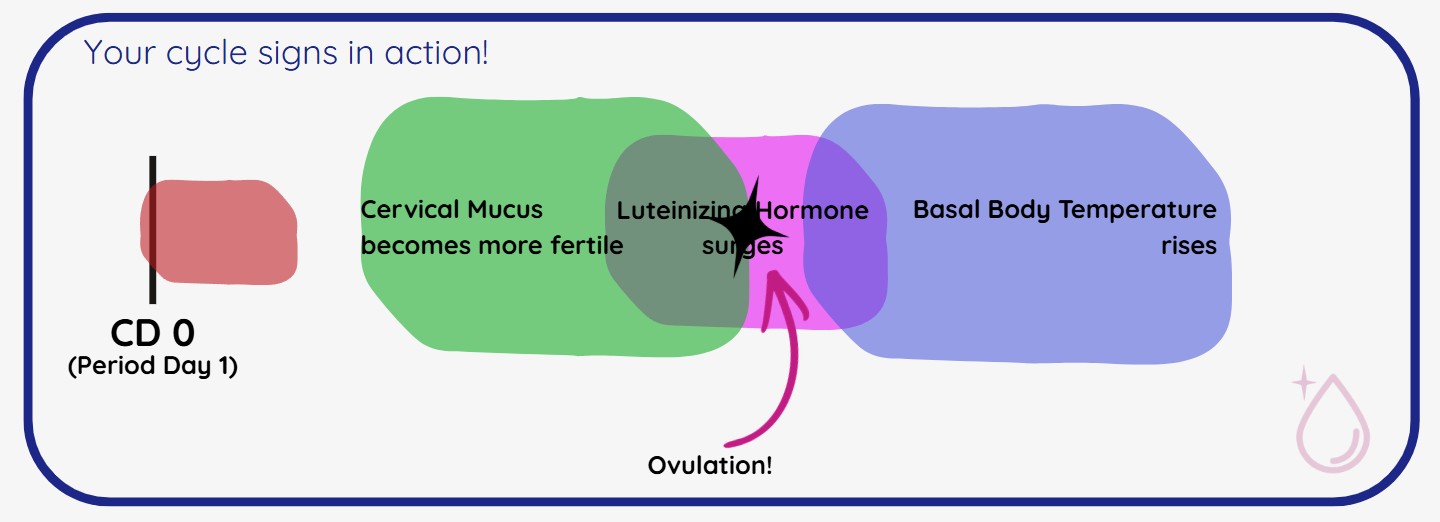
Your Cycle Signs In Action
Cycle Day (CD) 1 is the first day of full flow (the first day you need to wear protection beyond a pantiliner).
Cervical Mucus (CM) becomes more fertile as ovulation approaches among other changes, due to rising estrogen.
Luteinizing Hormone (LH) surges are detectable in urine as ovulation is being attempted. Learn exactly how to track and identify your real LH surge in my live LH Surge Masterclass!
Ovulation happens
Basal Body Temperature rises after ovulation has occurred, due to progesterone rising.
You continue along the last phase of your cycle, the luteal phase until the end... when your next cycle will begin (or hopefully, you find you are pregnant)!
For each of us, this cycle can be different. For some it's faster, some it's slower or variable. Sometimes our body tries to ovulate and doesn't. Sometimes everything works but one part... and by tracking our cycles correctly we can gain insight into each step of the way.
Why This Matters So Much
Without understanding how ovulation works, it’s easy to miss your fertile window, start testing too early or too late, misinterpret late periods, or feel like something is wrong when it may not be.
That can lead to unnecessary stress, confusion, and heartbreak.
This is also why a “late” period with a negative pregnancy test can be so frustrating. In many cases, it does not mean something is wrong. It may simply mean ovulation happened later than expected, which shifts the timing of your period and your test result
The Good News
When you understand your cycle and know how to track it effectively, everything makes more sense.
That's when you are no longer guessing. You can:
Time intercourse with intention.
Understand what your body is and is not doing.
Interpret symptoms and test results with more clarity.
Make informed decisions instead of relying on hope or chance.
Most importantly, you gain confidence in your own body.
In fact, proper cycle tracking can cut your TTC time in half!
You Deserve to Understand Your Body
My hope is that learning the fundamentals of your cycle can help you skip some of the confusion, avoid unnecessary heartache, and move forward feeling informed and empowered. TTC is already a vulnerable journey, you should not have to navigate it in the dark.
To help you take the next step in understanding your own cycles, check out the Free Fertile Window Blueprint Bundle mini-course. It is designed to help provide clarity into your personal cycle timing and is the first step towards confidence navigating your own cycles.

Sources
Hambridge, H. L., Mumford, S. L., Matteson, K. A., Ye, A., Pollack, A. Z., Perkins, N. J., & Schisterman, E. F. (2016). Determining menstrual phase in human biobehavioral research: A review of considerations and challenges for the research team. Experimental and Clinical Psychopharmacology, 24(1), 1–12. https://doi.org/10.1037/pharm0000069
Howards, P. P., Schisterman, E. F., Wactawski-Wende, J., Trevisan, M., & Gaskins, A. J. (2011). Characterization and reproducibility of menstrual cycle characteristics in the BioCycle Study. American Journal of Epidemiology, 173(2), 263–270. https://doi.org/10.1093/aje/kwq336